
Membrane Switch Testing Without the Failure Points
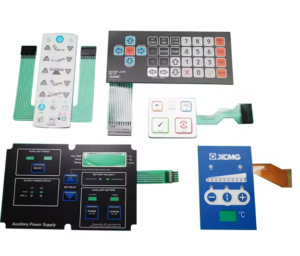
Membrane switches and flexible circuits are widely used across industrial, medical, and consumer electronics. While the devices themselves are reliable, the test interface is often the weakest part of the system.
Most production setups still rely on direct insertion into ZIF connectors or temporary cable interfaces. These approaches work—but they introduce failure modes that impact yield, throughput, and long-term reliability.
This is where purpose-built test fixtures make a difference.
Where Traditional Test Methods Fall Short
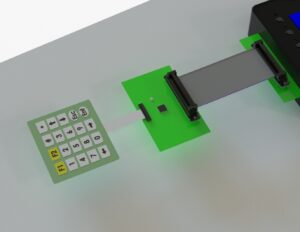
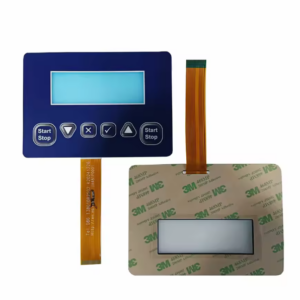
A typical membrane switch test setup involves manually inserting a flex tail into a connector, running the test, and removing it. Over time, this creates several issues:
- Connector wear
ZIF connectors are not designed for continuous high-cycle production use. Contact reliability degrades as cycle count increases. - Inconsistent contact conditions
Small variations in insertion depth, alignment, or angle can result in intermittent connections and false failures. - Operator-dependent results
Even with trained operators, repeatability is difficult to maintain across shifts and production runs. - Risk to the DUT
Flexible tails are susceptible to creasing, tearing, and contact damage from repeated handling.
These issues are often misdiagnosed as product defects when they are actually caused by the test interface.
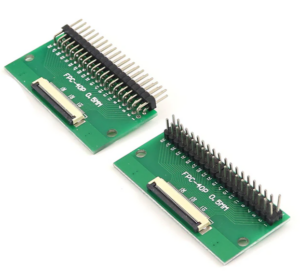
A More Stable Interface: Elastomeric Test Fixtures
A more robust approach is to remove the connector from the equation entirely.
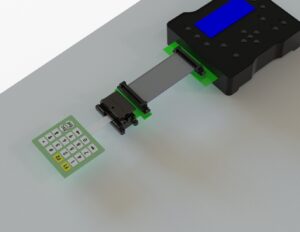
Flexible Test fixtures use elastomeric interposers to create a consistent electrical interface between the device under test (DUT) and the test system. Instead of inserting a flex into a connector, the DUT is placed into a fixture where contact is made through controlled compression.
The interface becomes:
DUT → Fixture → Test System
This approach isolates the DUT from the mechanical variability of connectors and manual insertion.
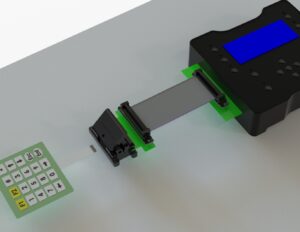
Why This Approach Works
High Cycle Capability
Elastomeric contacts are well-suited for repetitive use in production environments. Typical applications exceed 10,000 cycles, with many reaching significantly higher depending on the design.
There are no fragile latch mechanisms or sliding contacts to wear out.
Repeatable Contact Geometry
Each test cycle applies a controlled, uniform compression across all contact points. This removes variability caused by:
- Insertion depth
- Angular misalignment
- Uneven contact pressure
The result is consistent electrical performance from part to part.
Reduced Operator Influence
The workflow becomes straightforward:
Place DUT → Close fixture → Run test → Remove DUT
There is no cable insertion step, and no reliance on operator technique to establish contact. This reduces training requirements and improves throughput consistency.
Protection of the Device Under Test
By eliminating repeated connector insertion, the DUT is protected from:
- Edge wear on contact pads
- Flex tail fatigue
- Mechanical damage during handling
This is particularly important for thin or high-density flexible circuits.
Designed for Real Production Environments
Flexible Test fixtures are built as production tools.
Typical configurations include:
- Integration with existing test systems via flex or PCB interfaces
- Support for pads-up or pads-down DUT orientations
- Custom nests for repeatable alignment
- Replaceable contact elements for long-term serviceability
Each fixture is designed around the specific geometry and test requirements of the application.
When to Consider This Approach
Elastomeric interposer fixtures are especially effective when:
- Test volumes are high and connector wear is a concern
- Contact pitch is fine or alignment is critical
- DUTs are sensitive to mechanical stress
- False failures are impacting yield or debugging time
Summary
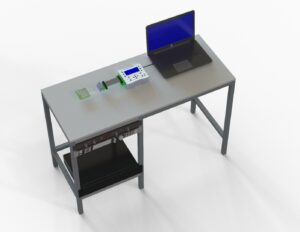
In many membrane switch applications, the limiting factor in test reliability is not the device—it is the interface.
By replacing connector-based insertion with a controlled elastomeric interface, manufacturers can improve consistency, reduce wear-related failures, and simplify the testing process.
For production environments where repeatability and uptime matter, this shift in approach can have a measurable impact.
If you are evaluating improvements to your membrane switch testing process, Flexible Test can help design a fixture tailored to your application.