
FFC Test Fixtures as a Reliable, High-Cycle Alternative to Traditional ZIF Connectors
Flexible Flat Cables (FFC) and Flexible Printed Circuits (FPC) are widely used in modern electronic assemblies, including cameras, displays, medical devices, and embedded systems. These cables are typically connected to printed circuit boards using compact Zero Insertion Force (ZIF) connectors.
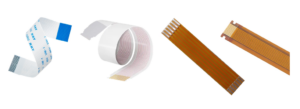
While ZIF connectors are effective for permanent or infrequently serviced connections, they present challenges in applications requiring frequent cable insertion and removal. Their small locking mechanisms can be difficult to access, particularly in densely populated assemblies, and are susceptible to damage from repeated handling.
FlexibleTest FFC/FPC test fixtures provide a robust, industrial-grade alternative designed for more than 10,000 mating cycles.
These fixtures utilize elastomeric connector technology to establish reliable electrical contact without relying on the delicate locking mechanisms found in traditional ZIF connectors.

Using FlexibleTest as an FFC/FPC Interposer
One practical application of FlexibleTest technology is using the fixture as an interposer between an existing PCB connector and an FFC/FPC cable.
Rather than repeatedly connecting and disconnecting cables directly from the PCB-mounted ZIF connector, a short intermediate cable can remain installed while the FlexibleTest fixture provides an accessible, reusable connection point.
This approach offers several advantages:
- 10,000+ mating cycles for repeated cable insertion and removal.
- Reduced connector damage by minimizing interaction with the original PCB-mounted ZIF connector.
- Improved accessibility when working with compact or densely populated assemblies.
- Industrial-grade construction suitable for engineering laboratories and production environments.
- High-density connectivity for a variety of cable pitches and conductor configurations.
By relocating the connection point, FlexibleTest fixtures can simplify testing while helping extend the service life of the equipment being used.
Demonstrating FlexibleTest with a Raspberry Pi Camera Interface
To demonstrate this application, we are developing a test setup using a Raspberry Pi 3 Model B+ and an Arducam 8MP IMX219 camera module.
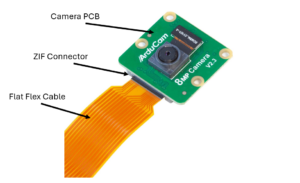
The camera communicates with the Raspberry Pi using the MIPI CSI-2 interface, which transmits high-speed image data through differential signaling pairs carried by a flexible ribbon cable.
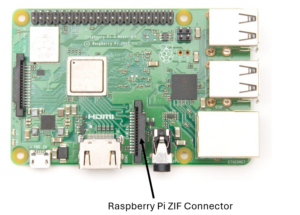
The Raspberry Pi’s onboard camera ZIF connector is relatively small and can be difficult to access, particularly when the board is installed inside an enclosure or integrated into a larger assembly. Repeatedly opening and closing its locking mechanism increases the risk of damage.
Camera Interface Specifications
| Parameter | Specification |
|---|---|
| Image Sensor | Sony IMX219 |
| Resolution | 8 Megapixels (3280 × 2464) |
| Communication Interface | MIPI CSI-2 |
| Physical Layer | MIPI D-PHY |
| Data Lanes | 2 Differential Data Lanes |
| Clock | Dedicated Differential Clock Lane |
| Data Rate | Approximately 912 Mbps per lane in a typical Raspberry Pi configuration |
| Aggregate Signaling Rate | Approximately 1.82 Gbps across two lanes |
| Video Capabilities | 1080p at 30 fps, 720p at 60 fps |
| Camera Connection | 22-Contact FFC/FPC |
| Raspberry Pi Connection | 15-Contact CSI Connector |
These specifications highlight the high-speed signaling requirements of a relatively common embedded camera system. Even compact, low-cost camera modules rely on interconnects capable of carrying data at hundreds of megabits per second per lane.
The Raspberry Pi’s onboard camera ZIF connector is relatively small and can be difficult to access, particularly when the board is installed inside an enclosure or integrated into a larger assembly. Repeatedly opening and closing its locking mechanism increases the risk of damage.
Our demonstration incorporates a FlexibleTest FFC fixture into the camera cable path, allowing the camera cable to be connected and disconnected without repeatedly operating the Raspberry Pi’s original ZIF connector.
The setup uses a 22-contact camera flex interface with an appropriate transition to the Raspberry Pi 3 Model B+’s 15-contact CSI connector.
Evaluating High-Speed Performance
In addition to demonstrating the mechanical advantages of a high-cycle test fixture, this setup provides an opportunity to evaluate FlexibleTest technology in a practical high-speed digital application.
FlexibleTest fixtures utilize elastomeric connector technology to establish electrical contact between the flexible circuit and mating conductors. Their compact contact structure makes them suitable for consideration in applications involving high-density and high-speed signals.
For interfaces such as MIPI CSI-2, several electrical characteristics are important:
- Signal Integrity: Maintaining reliable transmission of high-speed differential signals through the complete interconnect.
- Impedance Matching: Minimizing impedance discontinuities that can cause signal reflections.
- Insertion Loss: Limiting signal attenuation through the fixture and cable assembly.
- Crosstalk: Reducing unwanted coupling between adjacent signal paths.
- Contact Reliability: Maintaining consistent electrical performance through repeated cable insertions.
Our completed demonstration setup illustrates how an industrial-grade FlexibleTest fixture can be integrated into an existing high-speed digital interface while providing a more accessible connection point for repeated testing.
Live camera operation through the fixture can provide functional evidence of the interposer concept, while additional electrical characterization is required to establish specific bandwidth and signal-integrity performance limits.
This application highlights how FlexibleTest fixtures can provide more than a durable connection for low-speed electrical testing. With appropriate interconnect design and validation, they can also support test applications involving high-speed digital components.
Applications Beyond Embedded Camera Systems
Although the Raspberry Pi provides a convenient demonstration platform, the same interposer approach can be applied across a wide range of electronic products.
In engineering development, FlexibleTest fixtures allow engineers to repeatedly connect and disconnect flexible circuits during debugging, validation, and prototype evaluation.
For production and end-of-line testing, the fixtures provide a durable connection interface for repeated testing of assemblies containing FFC/FPC cables.
In medical electronics, displays, sensors, and industrial equipment, FlexibleTest fixtures can improve access to compact interconnects while reducing the risk of damaging expensive or difficult-to-replace PCB connectors.
The ability to incorporate a high-cycle connection point is particularly valuable when the original connector was designed primarily for final product assembly rather than repeated testing.
A More Durable Approach to Flexible Circuit Testing
Traditional ZIF connectors remain an effective solution for compact electronic assemblies, but their mechanical design is not always ideal for applications requiring frequent cable changes.
With a service life exceeding 10,000 mating cycles, Z-Axis FlexibleTest fixtures provide an alternative for engineers looking to improve connection reliability, accessibility, and durability.
Our Raspberry Pi camera demonstration illustrates how FlexibleTest technology can be incorporated into an existing electronic system as a reusable interposer, protecting the original connector while providing a practical interface for repeated testing.
Z-Axis Connector Company offers FlexibleTest FFC/FPC test fixtures for a wide range of cable pitches, conductor counts, and application requirements.
Contact our engineering team to discuss your FFC/FPC testing application and explore available fixture configurations.